Goodbye toot.community
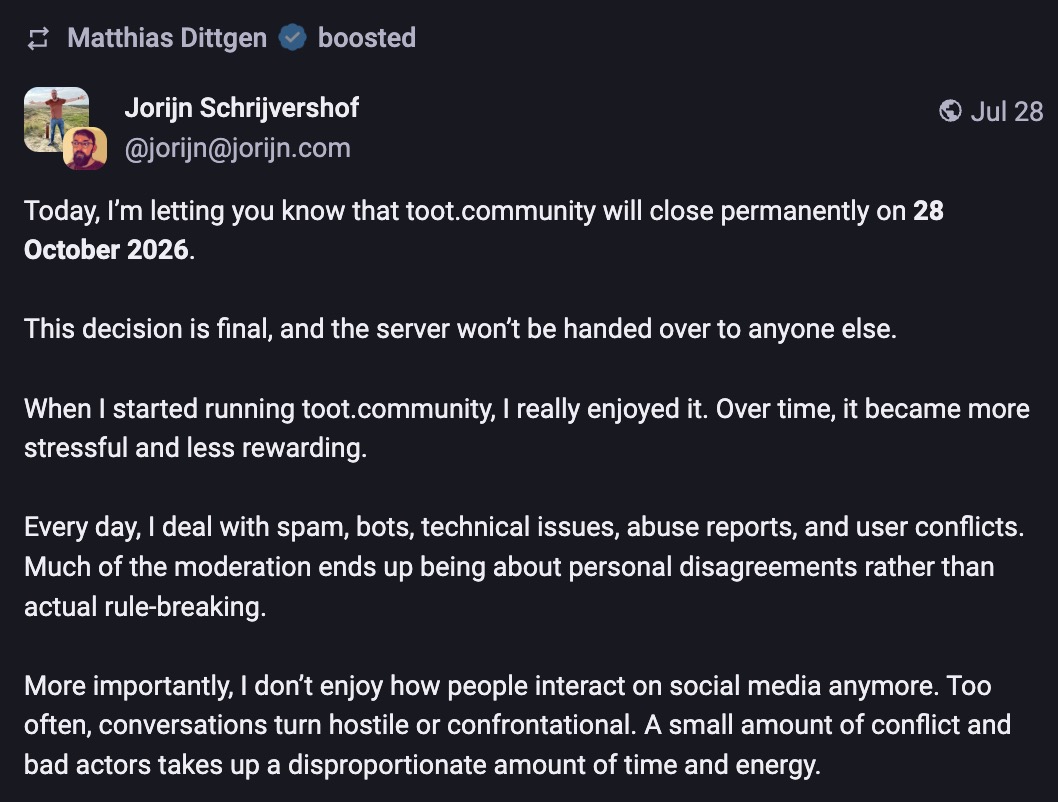
A few days ago, @jorijn announced that the Mastodon instance he runs, toot.community, will be shutting down in a few days.
The sad thing is that, besides the technical issues, I read between the lines of Jorijn’s announcement that the shutdown is probably more related to social than technical issues, things like spam, abuse reports, user conflicts, and, more generally, the way people interact with each other on social media nowadays.
It certainly surprised me, but I also have full understanding and therefore a few thoughts on it.
Why I Joined toot.community»
I have been active there since November 2022 and posted quite a few things over the years, particularly about OpenSCAD experiments and 3D printing projects.
The better Twitter?»
I joined Mastodon after Twitter/X had increasingly turned into a platform that no longer felt like a good place to exchange ideas and talk about projects.
I joined Twitter/X back in December 2008. At the time, it was mainly a place to follow other people from my IT bubble and keep up with the latest developments in technology.
I could get quite sentimental thinking back to those days. There was a time when quite a few other Flash developers were active on Twitter, and you could exchange ideas about what was happening in the Flash world. There were even job title like “Evangelist” or “Developer Advocate”, and these guys and others used to be our Heroes. After the end of the Flash era, you could continue following the people you had looked up to as they moved on to new things — whether iOS development, Unity3D, WebGL, or whatever else they were working on.
Twitter was also what it was originally meant to be: a microblogging platform. Short posts that were quick to write and quick to read, with a certain amount of interaction because you followed people and they followed you back.
It made the world feel smaller and more familiar. Somehow, people felt a little closer.
Unfortunately, things don’t always stay the same. Over the years, Twitter changed more and more, and after Elon Musk took over, the platform moved in a direction that I simply didn’t enjoy anymore. And I wasn’t alone. Many people left Twitter and moved either to the Fediverse or to Bluesky.
I have tried both. And with that comes the hope that these platforms can bring back a piece of the original Twitter feeling. But can they do that, and can they do it permanently?
So, What Exactly is the Fediverse and Mastodon?»
The Fediverse is a decentralized network of independent social-media platforms and communities that can communicate with each other.
Each instance is operated independently and has its own community, rules, and administrators, but users can still interact with people on other instances. This is made possible by protocols such as ActivityPub, which define how posts (toots), follows, likes, and other interactions are exchanged between different services.
Mastodon is one of the best-known platforms in the Fediverse, but it is not the only one.
Here is a small glossary of some of the terms you are likely to encounter:
- An open-source social-networking platform based on the ActivityPub protocol. It allows users to publish posts and interact with other users across the Fediverse.
- An individual installation of Mastodon or another ActivityPub-based platform, operated by a person, group, or organization. Each instance has its own community and rules, while still being able to communicate with other instances.
- A network of decentralized social platforms that can communicate with one another. Besides Mastodon, platforms such as PeerTube, Pixelfed, and Friendica are part of the Fediverse and use ActivityPub.
- An open protocol that enables different social platforms and services to communicate with each other. It defines how posts and interactions are exchanged.
- A post on Mastodon. The term was originally used as a playful alternative to "tweet."
- Sharing someone else's post on Mastodon, similar to retweeting on Twitter. A boosted post appears in your followers' feeds.
- The process that connects different instances and allows their users to interact with each other.
- Another decentralized social-media platform, but unlike Mastodon it does **not** use ActivityPub. Bluesky is based on its own decentralized protocol, the AT Protocol (ATProto). It was originally initiated by Twitter co-founder Jack Dorsey.
Mastodon and toot.community»
I decided to join an instance that appealed to me. Since a post on Mastodon is called a ”toot”, the name toot.community seemed like a good fit.
And I wasn’t disappointed. The instance gave me a little home in the Fediverse where I could connect with people who shared some of my interests.
The fact that Jorijn, the person running toot.community, is from the Netherlands also contributed to the fact that I felt comfortable there. Gezellig, as the Dutch would say.
He ran the instance with a lot of passion, taking care of both the technical side and the community. I really enjoy spending holidays in the Netherlands and have always found the country tidy, clean, and beautiful. The people I have met there have also been incredibly friendly and helpful. Somehow, some of that feeling carried over to the instance as well.
I never expected it to be temporary.
Mastodon’s decentralized and somewhat technical nature tends to attract people who are interested in technology and don’t mind getting into the details of how things work. That means I tend to get a fair amount of interaction on the topics I post about.
Other interests of mine, such as Svelte, get more attention on Bluesky. The creator of Svelte, Rich Harris, is active there, and there is a very active Svelte community around him.
That’s why I never really settled on just one platform. I use several of them in parallel. I haven’t abandoned my old Twitter account either — partly because I’m attached to the history I’ve built up there.
But having so many social networks to keep up with can be exhausting.
What Comes After toot.community?»
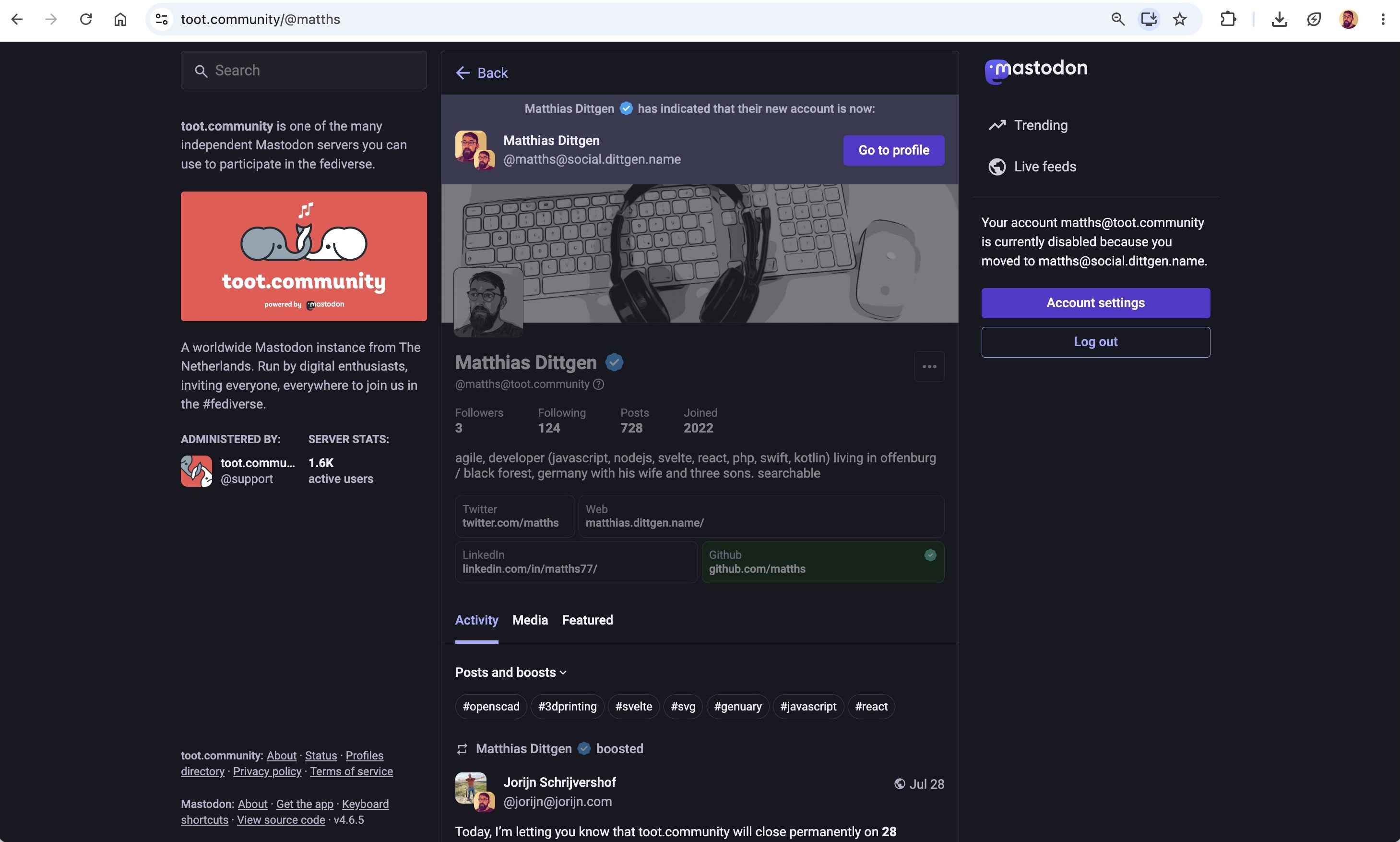
When I heard that toot.community was going to shut down, I realized I needed to save my posts before they disappeared.
The solution: my own little instance on my VPS.
Jorijn had already shown me the way. He runs his own instance using GoToSocial, a lightweight open-source ActivityPub server that he hosts on his own infrastructure.
I decided to go with snac2 instead. It looked even more lightweight to me and seemed like a good fit for running on my cheap VPS.
I’ll write about how the migration went in a separate blog post, which I plan to publish in the next few days.